January rarely announces itself as a turning point for retail tech, but the retail tech news in January 2026 sure did.
Usually January is about earnings previews, trend forecasts, cautious optimism, and the usual insights coming out of flagship events like NRF. But this January was different because of how many foundational shifts arrived at once. Across AI, physical retail, luxury, sustainability, and brand survival, the industry sent a clear message: retail is changing quickly as shopping is becoming delegated and visibility is becoming machine first with the onslaught of retail tech, fueled by AI.
Below is the retail tech news from January, alongside Shoptalk Luxe, that signaled shifts in the retail landscape and set the tone for 2026 ahead.
Google Pushes Commerce from Search to Delegation
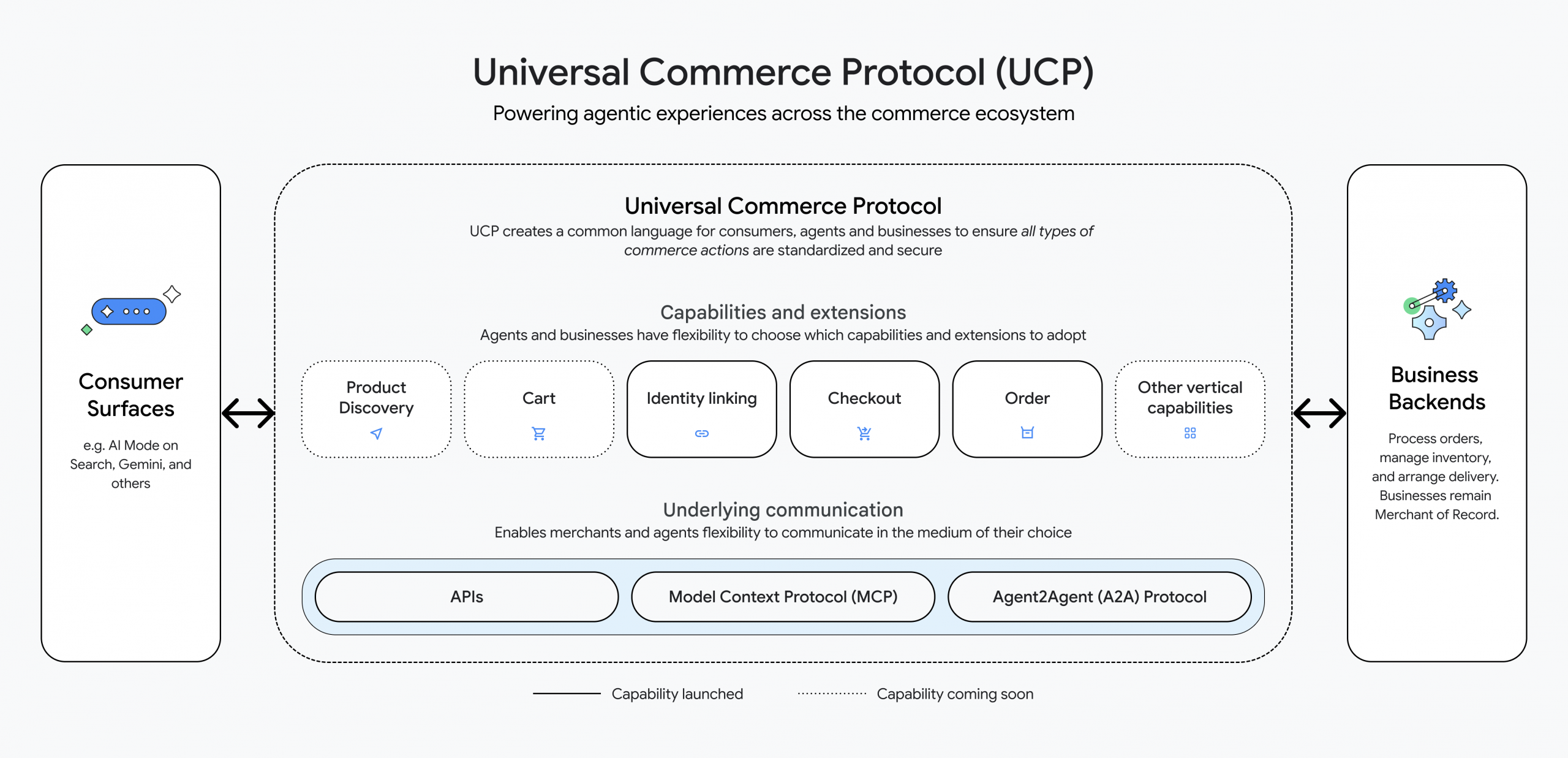
Google took a step toward agent led commerce with the launch of its Universal Commerce Protocol (UCP), alongside deeper integrations of Gemini into shopping and checkout flows with major retail partners.
UCP establishes a shared, machine readable language that allows AI agents to discover products, compare options, execute purchases, and manage post‑purchase actions across platforms. Shopify and other major commerce players committed early, signaling broad industry buy in. The ambition is clear to listen to shifting consumer buying behavior and collapse the traditional funnel into an AI mediated experience where intent, not browsing, drives action.
What does this mean for retail?
- Discovery is shifting from human‑led browsing to AI led delegation.
- Retailers without machine readable infrastructure risk invisibility as agents default to UCP enabled sources.
- Brand storytelling won’t disappear, but it will increasingly happen after selection, not before
Walmart Aligns with Google Gemini for AI as a Primary Shopping Interface
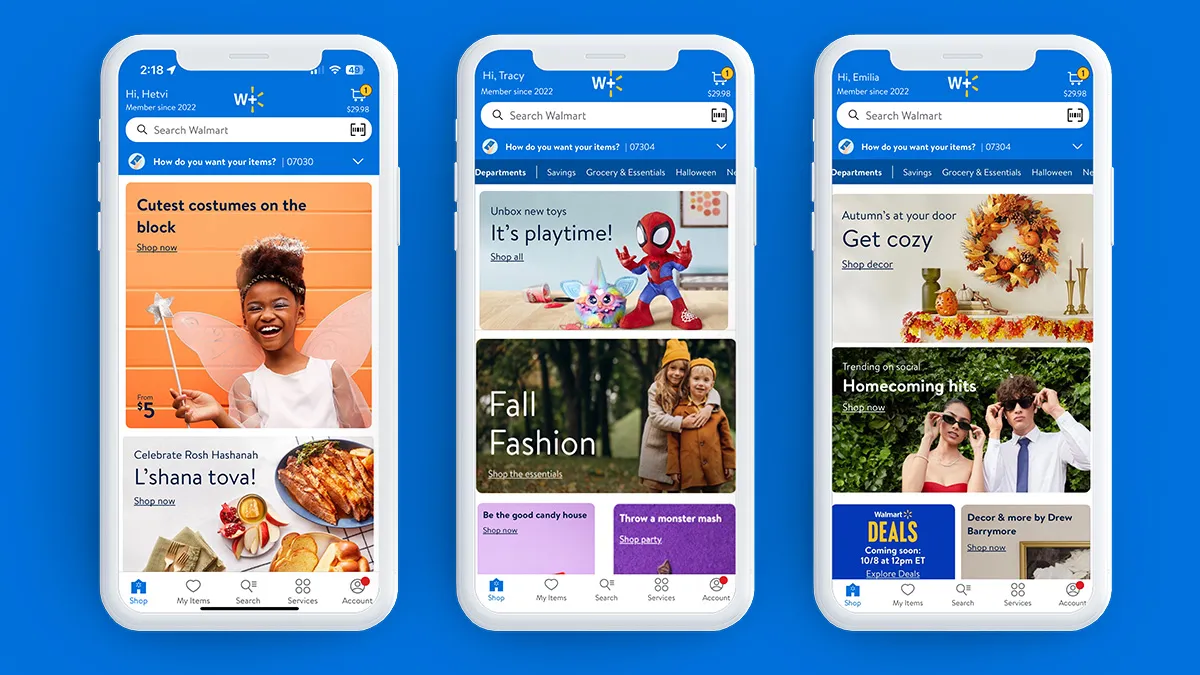
Walmart expanded its partnership with Google to integrate Gemini directly into commerce experiences, allowing users to discover, evaluate, and purchase Walmart products inside conversational AI environments.
Rather than treating AI as a marketing layer, Walmart is positioning itself as a fulfillment and inventory backbone for agent led shopping, where the question isn’t “where should I shop?” but “who can execute this best for me?”
What does this mean for retail?
- Scale retailers are competing to become default execution layers for AI agents.
- Loyalty may increasingly be earned through reliability, speed, and trust, not brand preference alone.
- The battleground shifts from front‑end experience to back‑end capability.
Levi’s Reframes Ownership in an Automated World
Levi’s launched a national repair and reuse initiative aimed squarely at Gen Z, teaching practical skills like mending, tailoring, and garment care. The brand cited research showing that a significant portion of younger consumers lack repair skills, but want to keep clothing longer if empowered to do so. Rather than pushing more product, Levi’s is investing in longevity, positioning ownership as stewardship rather than replacement.
What does this mean for retail?
- As buying becomes easier and more automated, brands must add meaning after the transaction.
- Durability and care are becoming part of the value proposition.
- Sustainability is evolving from messaging to participation.
Apple Draws a Hard Line Around Privacy
Apple detailed its Private Cloud Compute architecture, reinforcing privacy as a product choice and not a policy footnote. The approach allows advanced AI processing while minimizing data exposure, keeping sensitive user information protected even as AI capabilities scale.In a moment where AI systems increasingly act on behalf of consumers, Apple is making a clear bet that trust will be a competitive advantage.
What does this mean for retail?
- Consumer trust is fragmenting between open utility platforms and protected ecosystems.
- Retailers operating within privacy‑forward environments may gain credibility, but face stricter data constraints.
- Identity management will matter as much as personalization.
Amazon Rethinks Physical Retail, Again
Amazon announced plans for a large format physical retail concept while simultaneously shuttering all Amazon Go and Amazon Fresh stores. The move reflects prioritizing scalable grocery delivery, Whole Foods expansion, and fewer, but more intentional, physical footprints, oscillating the phygital space for its offerings, which we’ve discussed is a trend in retail before. Experimentation hasn’t stopped. But novelty alone is no longer enough.
What does this mean for retail?
- Physical stores must justify themselves as experience hubs, logistics assets, or both.
- Proximity and fulfillment matter more than tech spectacle.
- Even the most data driven retailer is reassessing what physical retail should be for.
Saks Global files for Chapter 11
Saks Global entered Chapter 11 bankruptcy, underscoring the vulnerability of legacy prestige without structural differentiation. Brand equity alone proved insufficient amid margin pressure, operational complexity, and shifting consumer expectations.
What does this mean for retail?
- Status is no longer a merit alone.
- Luxury must earn relevance through experience, clarity, and operational discipline.
- The middleground in retail which is neither truly premium nor truly accessible is increasingly fragile.

Pat McGrath Labs seeks Chapter 11 protection
Pat McGrath Labs, one of the most culturally influential beauty brands of the past decade, filed for Chapter 11 citing an unsustainable capital structure, legacy liabilities, and liquidity constraints. Consumer demand remains strong, but financial fundamentals faltered.
What does this mean for retail?
- Cultural relevance and love of the social media world does not guarantee commercial durability.
- Founder led brands must balance vision with capital discipline.
- Scale amplifies both success and structural weakness.
AI Is Redefining Discovery with Checkout at the Center
The first Shoptalk Luxe echoed a consistent theme: luxury leaders are operating in complexity, but winning through relevance, reinvention and deeper customer connection. AI driven discovery emerged as one of the clearest shifts, backed by data shared by Deann Evans from Shopify:
- 51% of Gen Z start product search in AI.
- Google’s AI Overview now reaches ~70% of users
- Orders from AI channels are up ~20%
- AOV from AI-driven orders is ~40% higher
As discovery and purchase converge, checkout remains “the crown jewel.” Evans emphasized the importance of showing up where customers search, integrating once across channels, keeping product data accurate, and maintaining control of the commerce stack, which is a strategy reinforced by Shopify opening its catalog to all brands, regardless of ecommerce platform. This message was echoed by brands preparing for the next phase of AI adoption. Monica Vinader stressed that agentic AI only works if data is accurate, connected, and ready: “Get on the AI train or get run over.”
Other Insights and Retail Tech News from Shoptalk Luxe
Beyond AI, several additional themes surfaced repeatedly across sessions:
- Reinvention as a constant: Michael Chalhoub (Chalhoub Group) emphasized continuous reinvention, stating, “Let’s disrupt ourselves before we get disrupted.” Relevance requires reassessing competitive advantage and similarly, Christian Louboutin CEO Alexis Mourot echoed a similar sentiment that the brand would “rather not open a store if it doesn’t make sense,” prioritizing control and protection of its DNA.
- Omnichannel is contextual: Away shared that success is measured by sell-out rates, not channel preference, with store formats and assortments adapted by region. Reformation demonstrated how tech can enhance human service through boutique formats and mobile dressing rooms, while Hermès reinforced that tech and human interaction should feel like one unified, intuitive experience.
- Customer intimacy still wins: Despite real time data and AI, brands highlighted direct human connection. Pandora emphasized giving store associates time to tell the product story. Casablanca Paris cited ~20% response rates from customer surveys and shared how direct phone calls during tariff changes helped customers avoid costs. Monica Vinader reinforced continuity of relationships through formats like live shopping.
- Sustainability expectations vs. economics: The HUGO BOSS CEO described significant investment in sustainability as part of the second phase of the “Claim 5” strategy, while acknowledging the challenge of scale and willingness to pay: consumers value sustainability, but don’t want to pay more. Nobody’s Child echoed this balance, pairing sustainability with affordability while reporting £118M in gross revenue.
- Technology must solve real problems: Across panels, leaders agreed that technology itself isn’t the constraint, but partnership fit is. Brands emphasized working with partners who understand the business, speak the same language, and are accountable for outcomes.
In conclusion, the retail signals beneath the noise for 2026
None of these pieces of retail tech news bytes are unprecedented on their own. What’s different is their convergence, because when taken together, they point to a realignment of sorts, something we saw last year too:
- Visibility is becoming machine readable before human readable, as retailers structure product data, pricing, and availability for AI agents to interpret and act on (not just for people to browse.
- Retail is moving from discovery to delegation, with consumers increasingly relying on AI systems to recommend, reorder, and execute purchases on their behalf.
- Trust is diverging between utility and identity, forcing brands to navigate a split between open platforms optimized for scale and convenience, and closed systems designed to protect privacy, control, and personal data.
- Physical stores are being reexamined as both experience and proximity, serving not only as brand touchpoints but also as fulfillment hubs that support logistics.
- Ownership is becoming more intentional as buying becomes automated, pushing brands to create value beyond the transaction through durability, repair, reuse, etc.
- Legacy is being tested in an agent led economy, where brand heritage and cultural relevance do not necessarily guarantee resilience without strong operations, financial discipline, or adaptability.
One month doesn’t always change an industry, but sometimes it compresses enough signals that the direction becomes impossible to ignore.
Yael Kochman is the CEO at Re:Tech, a retail technology innovation hub helping brands and retailers worldwide to foster innovation at scale. She is also the GM of Syte by Nayax, a discovery and personalization platform foe retail.
Latest posts by Yael Kochman
(see all)


Recent Comments